
Custom Search
Historical Context
When Hurricane Ike reached landfall on September 12 -13, 2008, the Rosenberg Library had stood as a literary and cultural landmark on the island of Galveston for 104 years. Commissioned by the Board of Directors, the architectural firm of Eames & Young of St. Louis designed the handsome Italian-renaissance style building, which would come to house not only the library collection, but also the Historical Society and the Museum. The three-story building cost $155,000 and was dedicated on benefactor Henry Rosenberg’s birthday, June 22, 1904 and opened with a collection of 7,000 books. Rosenberg immigrated to the United States in 1843 from Switzerland when he was twenty-one years old. He settled in Galveston and a career in baking, real estate and transportation left him with a fortune when he passed away in 1893. His desire to leave something memorable for the residents of Galveston, "... I desire to express in a practical form my affection for the city of my adoption and for the people among whom I have lived for so many years, trusting that it will aid their intellectual and moral development, and be a source of pleasure and profit to them and their children, and their children's children, through many generations"(The Rosenberg Library), and his bequest to the city, established the Rosenberg Library Association and made construction of the library a reality.
From its inception, the Rosenberg Library held a place of cultural importance in Galveston, sponsoring early lecture series and programs that encouraged community involvement. Over the years the library acquired outstanding collections of manuscripts, maps, artifacts, and other collectible items (History of the Rosenberg Library). Housed within the library is The Galveston and Texas History Center whose collections include major manuscript collections, historical records of Galveston and an extensive map collection dating from the 1500’s. The Museum holding include historical artifacts and paintings relating to the early history of Galveston and Texas, Russian and Greek icons as well as a rare book collection (History of the Rosenberg Library).
Today the Rosenberg Library is a literary center for the city whose collection includes over 5,000 reference books and a circulating collection of over 250,000 books. Over the years, the library continued its rich heritage of offering art and cultural events, including film series and art exhibits. Meeting rooms on the third floor hosted over 1,600 meetings annually. Supported by the county of Galveston since 1941, the library receives approximately 75% of its budget from public funds and the remaining 25% from gifts and private endowments. Headquartered there is also the Galveston County Library System. The Rosenberg Library underwent a renovation in 1971 that more than doubled its size to 75,000 sq. ft. when the Moody Wing was added.
National Weather Service Advisory
At 4:19 PM on September 11, 2008 the National Oceanic and Atmospheric Administration issued this National Weather Service Advisory for the Galveston area.
URGENT - IMMEDIATE BROADCAST REQUESTED
HURRICANE IKE LOCAL STATEMENT
NATIONAL WEATHER SERVICE HOUSTON/GALVESTON TX
419 PM CDT THU SEP 11 2008
...VERY LARGE HURRICANE IKE HEADING TOWARDS SOUTHEAST TEXAS...
AT 400 PM CDT...THE CENTER OF HURRICANE IKE WAS LOCATED NEAR LATITUDE 26.0 NORTH...LONGITUDE 89.4 WEST OR ABOUT 400 MILES EAST- SOUTHEAST OF GALVESTON TEXAS.
(National Oceanic and Atmospheric Administration 2008)HURRICANE IKE LOCAL STATEMENT
NATIONAL WEATHER SERVICE HOUSTON/GALVESTON TX
419 PM CDT THU SEP 11 2008
...VERY LARGE HURRICANE IKE HEADING TOWARDS SOUTHEAST TEXAS...
AT 400 PM CDT...THE CENTER OF HURRICANE IKE WAS LOCATED NEAR LATITUDE 26.0 NORTH...LONGITUDE 89.4 WEST OR ABOUT 400 MILES EAST- SOUTHEAST OF GALVESTON TEXAS.
Although the Mayor of Galveston issued a mandatory evacuation following this advisory on September 11, 2008, Hurricane Ike did not hit the island until the evening of September 12th. According to library director, John Augelli, in an interview with Library Journal (LJ) on September 23, 2008, “That was a storm that moved around. At one point, it was headed toward Galveston. Then it appeared to be headed to South Texas. Because it was unpredictable, it wasn’t until Thursday morning that they called for a mandatory evacuation of Galveston” (Augelli). But this was not the first hurricane that Galveston or the Rosenberg Library experienced that summer. “Just this summer, we were through three scares. The problem is sometimes these storms can go from tropical storm to Category 2. There was Eduard. Also Hurricane Gustav, which we were watching pretty carefully. It missed us. And there was Ike, which hit the island dead on” (Augelli). Immediately following landfall, communication was lost with the Rosenberg Library. The library website went down as did the phone system. What was not known at the time is that Library Director, John Augelli, and two additional library staff, Michele Quinn and Carol Wood were weathering the storm on the third floor of the library. “I was thinking it would be good to be there, to see what I could do” (Augelli). Prior to the storm making landfall, though, the library had begun to prepare for the disaster.
Preparations
“There was a Hurricane Policy in place and it was followed to the letter. After each hurricane scare we evaluated the policy and made any revisions department heads felt necessary “(Stanley). Stanley, Head of Children’s Services at the library described initial efforts to prepare for Ike in a post on LJ,
“A department head meeting was held at 4:00 pm on the Wednesday before Hurricane Ike and Galveston was not expecting a direct hit from the storm at this time. The city had not issued evacuation orders except for the far west end of the island not protected by the seawall nor were they expecting to issue any. We were to return to the library on Thursday to ready the building for the ride. By 6:00 pm the entire situation had changed; staff busied themselves on Thursday morning
taking all necessary precautions as set out in our storm preparation policy. Throughout the entire ordeal John Augelli, Rosenberg Library’s executive director displayed leadership qualities that went above and beyond”.
Augelli, Carol Wood, Archivist, Casey Edward Green, Head of Special Collections, and other library employees moved as many items as possible from the first floor to avoid water damage. “Paintings and other historic materials were taken down from walls and hauled, without elevators, to higher floors” (Wood). In response to a comment criticizing the staff and library director posted on LibraryJournal.com, archivist Carol Wood stated, “As archivist, I did everything in my power to protect the historical records of the library. The preparations I undertook were methodical, thorough, and extensive, and carried out with a love for our fine historical collection and recognition of its value to the public”(Wood). While the rest of Galveston evacuated, Augelli, Wood, and Michelle Quinn, IT Systems Coordinator worked throughout the night to save as much of the historically-significant collection as possible.
Green described in detail the efforts of her department.
“Before the storm made landfall, my staff made extensive
preparations to protect and secure our artifacts and historical documents. The Museum staff removed valuable paintings, as well as the shadow box form the first floor Children’s Department, to the third floor. The Galveston and Texas History Center staff moved all archival materials to the vault and secured valuable documents by covering shelves with tarpaulins. Staff accomplished these tasks in a narrow time window. They completed preparations late Thursday morning, when the Mayor of Galveston had already ordered a mandatory evacuation” (Green).
preparations to protect and secure our artifacts and historical documents. The Museum staff removed valuable paintings, as well as the shadow box form the first floor Children’s Department, to the third floor. The Galveston and Texas History Center staff moved all archival materials to the vault and secured valuable documents by covering shelves with tarpaulins. Staff accomplished these tasks in a narrow time window. They completed preparations late Thursday morning, when the Mayor of Galveston had already ordered a mandatory evacuation” (Green).
Although there were several posts criticizing the staff of the Rosenberg Library, especially the actions of John Augelli, decisions were appropriately made to put efforts into preserving irreplaceable items with historical value. “People should know that it would be completely impractical to remove everything from the first floor of the library every time there is a hurricane threat and still keep the library running” (Quinn). “All historically valuable resources were removed from the first floor in advance of the storm. All new not yet processed were removed from the 1st floor, all rugs, toys, chairs, and magazines were placed higher. Computers were covered, important computer files were backed up, tremendous preparations were made by every department at the library” (Stanley).
Hurricane Ike Makes Landfall
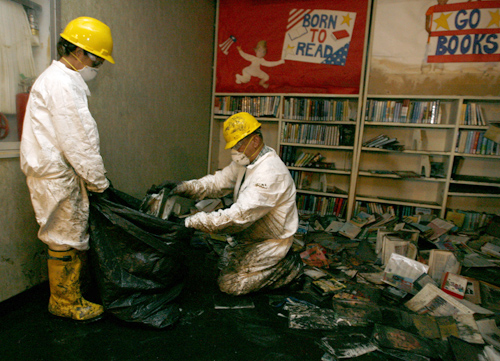
Once Ike made landfall, the wind damaged the roof and hurricane panels. The greatest damage to the library, however, was from the storm surge that left 75 inches of water on the first floor of the library. Not only was the children’s department destroyed, “the Wortham Auditorium, the Randall meeting room, circulation department, and the Friends sorting room and book shelf” (Galveston County Library). Aside from these losses, the most devastating damage was loss of all the building services that were located on the first floor. These included building systems located on the first floor including the loss of the major electrical panels, the telephone system, Internet routing equipment, library materials security system, components of the HVAC, elevator systems, storm protection panels, control panel of the fire and smoke detection system, the building security system and the video monitoring system (Galveston County Library).

Recovery Process
Because the library had a recovery plan in place, remediation began immediately. The recovery was made more difficult by the fact that all services that were on the first floor were wiped out, leaving text messaging as the only means of communication for Augelli as he arranged for the clean-up. On the Monday following the storm, Augelli contracted to have the water pumped out of the first floor and the mud removed. He worked quickly to have the mold on the first floor remediated as well as arranged air conditioning on the upper floors to ensure archival material wasn’t damaged by humidity. Augelli even cared for Rose, the pet skink in the Children’s Department, named for benefactor, Henry Rosenberg.
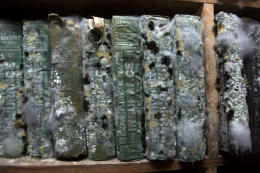
In assessing the damages, every book in the children’s department was destroyed and needed to be removed. Many had developed a thick coat of mold within a few days.
Fortunately, collections on the upper floors and items of historical value that were moved prior to the surge were saved. Due to the efforts of library staff, there was no damage to any historical documents or museum artifacts. After examining the Galveston and Texas History Center’s archives, Head of Special Collections, Casey Edwards Green found “no signs of mold infestation” (Green).
In the Spring 2009 Galveston County Library System News, an article outlined the progress made in the seven months since the Rosenberg Library was damaged and was accompanied by a Repair & Improvement Timeline (appendix 1). Staff and the Board of Directors have implemented a phased plan to restore services to the island residents. Although patrons can enter the library through the east entrance of the building, at that time they only had access to portions of the second floor Rosenberg Wing. The library took this opportunity to move all the building systems to the second floor as well as installing a more energy efficient lighting system on the second floor and mezzanine of the Moody Wing. The anticipated date of completion for this phase of the restoration is June 2009 and includes carpeting on the mezzanine, which will now house the computer lab.
$2.5 million of the anticipated $4 million recovery efforts have been funded through flood insurance (Turner), $225,000 in recovery funds from the Bush-Clinton Coastal Recovery Fund (Kever), with the remainder coming from grants, donations and payments from the Federal Emergency Management Agency. A grant awarded by the Texas Responds Grant through the Institute of Museum and Library Science and the Texas State Library Archives Commission, provided funds to purchase DVDs and over 2,000 children’s books which now line the shelves of the new Children’s Department.
Conclusion
Natural disasters such as hurricanes can devastate entire regions when they strike. While the National Oceanic and Atmospheric Administration monitors their progress, hurricanes are mercurial by nature. In August of 2008, with little prior warning, the staff of the Rosenberg Library in Galveston, Texas executed a Hurricane Policy which was in place and which was followed “to the letter”(Stanley). Immediately following the disaster, Library Director, John Augelli assessed the damages and began recovery efforts based on a Recovery Plan in place. As the entire children’s collection was damaged, there was no need for repair efforts. The building, however, has undergone extensive renovations, which are still ongoing at this time. The lessons learned from this natural disaster are that while no one is able to control or ultimately predict exactly when one will strike, with the proper policies in place and strong leadership from the administration, damage can sometimes be kept to a minimum in preserving irreplaceable collections and historical artifacts.
Appendix 1
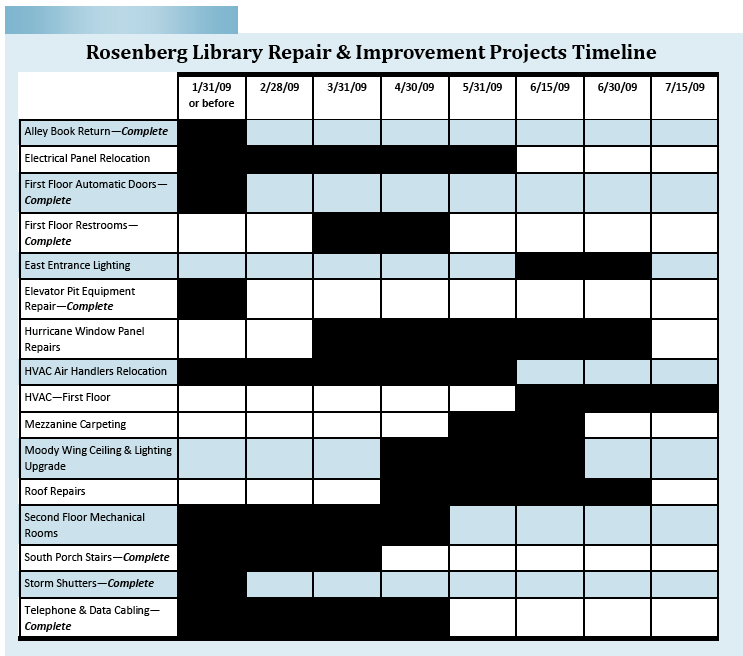
(Galveston County Library System News)
Works Cited
Augelli, John. Interview by Norman Oder. LibraryJournal.com. Library Journal, 23 Sept. 2008. Web. 13 Sept. 2009. <http://www.libraryjournal.com/index.asp?layout=talkbackCommentsFull&talk_back_header_id=6557332&articleid=CA6598457>.
The Daily News. “Rosenberg children’s collection ruined.” The Galveston County Daily News. A Galveston Newspapers Inc. Publication, 18 Sept. 2008. Web. 28 Sept. 2009.
Galveston County Library. “Galveston County Library System News.” Rosenberg Library. Rosenberg Library, Mar.-Apr. 2009. Web. Sept. 2009. <http://www.rosenberg-library.org/about/repairs/repairs.htm>.
Galveston County Library System, comp. “Galveston County Library System News.” Rosenberg Library . Rosenberg Library , Mar.-Apr. 2009. Web. 17 Sept. 2009. <http://www.rosenberg-library.org/about/gcls.htm>.
Green, Casey Edward. “LJ Talks to John Augelli, Executive Director of the Rosenberg Library, Galveston, TX.” Letter. LibraryJournal.com. Library Journal, 23 Sept. 2008. Web. 18 Sept. 2009. <http://www.libraryjournal.com/index.asp?layout=talkbackCommentsFull&talk_back_header_id=6557332&articleid=CA6598457>.
Kever, Jeannie. “Final Ike Recovery Funds Handed Out.” Houston Chronicle 23 Sept. 2009: n. pag. The Chronicle. Web. 28 Sept. 2009. <http://www.chron.com/disp/story.mpl/hurricane/ike/6633877.html>.
National Oceanic and Atmospheric Administration, comp. “Hurricane Ike - NOAA Advisory.” National Oceanic and Atmospheric Administration. United States Department of Commerce, 11 Sept. 2008. Web. 13 Sept. 2009. <http://www.noaa.gov/>.
Poom. “Rosenberg Library Recovers.” Rosenberg Library Blog. Rosenberg Library, 1 Oct. 2008. Web. 27 Sept. 2009. <http://rosenberglibrary.blogspot.com/2008/10/rosenberg-library-recovers.html>.
Quinn, Michele. “LJ Talks to John Augelli, Executive Director of the Rosenberg Library, Galveston, TX.” Letter. LibraryJournal.com. Library Journal, 25 Sept. 2008. Web. 18 Sept. 2009. <http://www.libraryjournal.com/index.asp?layout=talkbackCommentsFull&talk_back_header_id=6557332&articleid=CA6598457>.
The Rosenberg Library. “History of the Rosenberg Library.” The Rosenberg Library. The Rosenberg Library, 2009. Web. 13 Sept. 2009. <http://www.rosenberg-library.org/about/library.htm>.
Rosenberg Library. “Memories of Ike.” Rosenberg Library. Rosenberg Library, 2009. Web. 17 Sept. 2009. <http://images.google.com/imgres?imgurl=http://12.185.240.10/ike/Ike3.JPG&imgrefurl=http://12.185.240.10/ike/memories.htm&usg=__OydKpZXArr8S2YNZ5wtAzjjvGoU=&h=320&w=427&sz=41&hl=en&start=2&um=1&tbnid=qAWzpzE-7VrGxM:&tbnh=94&tbnw=126&prev=/images%3Fq%3Drosenberg%2Blibrary%2B%252B%2Bhurricane%2Bike%26hl%3Den%26client%3Dfirefox-a%26rls%3Dorg.mozilla:en-US:official%26sa%3DN%26um%3D1>.
Stanley, Karen, et al. “LJ Talks to John Augelli, Executive Director of the Rosenberg Library, Galveston, TX.” Letter. LibraryJournal.com. Library Journal, 25 Sept. 2008. Web. 18 Sept. 2009. <http://www.libraryjournal.com/index.asp?layout=talkbackCommentsFull&talk_back_header_id=6557332&articleid=CA6598457>.
Turner, Allan. “Ike Aftermath.” Houston Chronicle 11 July 2009: 1. The Chronicle. Web. 24 Sept. 2009. <http://www.chron.com/CDA/archives/archive.mpl?id=2009_4764431>.
Wood, Carol. “LJ Talks to John Augelli, Executive Director of the Rosenberg Library, Galveston, TX.” Letter. LibraryJournal.com. Library Journal, 2 Oct. 2008. Web. 18 Sept. 2009. <http://www.libraryjournal.com/index.asp?layout=talkbackCommentsFull&talk_back_header_id=6557332&articleid=CA6598457>.